


How to Choose the Best University for You (4 Steps for Success)

August 7, 2026 | 2 months | Hacks & Tips
In This Article:
- Decide What You Want from the University
- Be Realistic About Entry Requirements and Your Predicted Grades
- Things to Consider When Choosing a University
- Visit Before You Commit: How to Make the Most of Open Days
- Special Considerations: Mature, International and Online Learners
- Checklist: How to Pick a University from Your Shortlist
- FAQs
 Summarise this article with ChatGPT | Perplexity | Claude | Google AI Mode | Grok
Choosing the best university means choosing the right institution for you. It's a separate decision from picking your degree subject and from filling in the application itself.
Picking a university is one of the biggest decisions you'll make as a teenager, and it comes at the worst possible time: while you're juggling A-level deadlines.
The good news: there's a sensible order to it to avoid feeling (too) overwhelmed by the whole process:
- Decide what you actually want and what you can afford: subjects, lifestyle, and the distance from home.
- Check the grades match to make sure the entry requirements are realistic for your predicted grades.
- Compare your options on the factors that will affect your three years there.
- Visit before you commit. An open day will show you more about a school than a prospectus ever will.
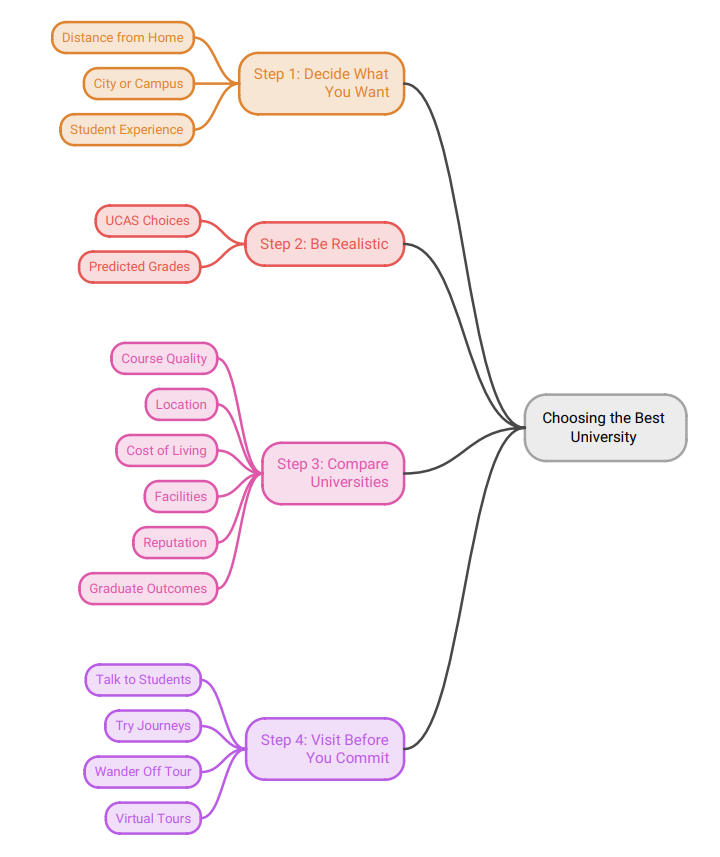
1) Decide What You Want from the University
Before you compare a single league table, get clear on what you're looking for. The best university for your friend might be a poor fit for you.
Start with your course. This is a clear non-negotiable: there's no point in falling for a campus that doesn't teach what you want to study.
If you're still weighing up your subject, our guide on choosing your A-level subjects is a good place to start. A strong subject choice shapes your degree options later.
Then think about the life around the course:
- How far from home do you want to be? Some students want a fresh start in a new city; others prefer to stay close enough to pop back at weekends.
- City or campus? A campus university puts everything in one place; a city university spreads you across town and into the buzz.
- What kind of student experience matters to you? Do you want to participate in sports or societies? Do you prefer a university that has a complete and quiet library, plenty of outdoor spaces, or a lively nightlife?
Think about what would be best for YOU. There are no right or wrong answers. The point is to set your own criteria before the marketing brochures start flooding you with theirs.
Don't Forget the Money
Keep in mind that what you want doesn't always match what you can afford. Knowing this before applying can save you a ton of headaches later in your uni years.
Money shapes some of your biggest choices: whether you can move away or need to stay local, and whether you'll rely on a maintenance loan, a scholarship, or a part-time job.
A few things worth knowing early:
- Most UK students take out tuition fee loans and maintenance loans through Student Finance, and the amount you can borrow for living costs depends partly on where you study and your household income.
- Many universities offer their own scholarships (for grades, sport or specific backgrounds) and bursaries for students from lower-income households.
- Living at home can cut your costs dramatically (but you must weigh this against the experience of moving to a new city).
2) Be Realistic About Entry Requirements and Your Predicted Grades
Here's what most students fail to notice before applying: matching universities to the grades you're actually on track to get.
Every course lists its entry requirements on UCAS. Your job is to be honest about where your predicted grades sit against them.
A good rule of thumb when you build your five UCAS choices is to spread them:
- Aspirational: Pick (just) one course where the entry requirements are a bit of a stretch, but you're still adamant about.
- Realistic: Pick two or three courses that match your predicted grades closely. This should be most of your application.
- Safe: Pick at least one option you'd comfortably meet, so you're not left without a place.
If a results day didn't go to plan, and you're worried about the effect it might have on your application, read about what to do when your results aren't what you hoped and what to do if you fail your A-levels.
Did You Know CloudLearn Offers a University Preparation Programme?
Alongside your GCSE or A-Level studies, get expert guidance on personal statements, UCAS, and securing your place at university.
Find out more
3) Things to Consider When Choosing a University
Once you've got a shortlist that fits your course and your grades, it's time to compare them. These are the six factors worth weighing.

Course Quality and Teaching Style
Two universities can offer the "same" degree but teach it in a completely different way.
Look at how each course is structured: lecture-heavy or seminar-led, exam-based or coursework-based, with or without a placement year. And read the module list thoroughly, not just the course title.
Location: Home or Away, City or Campus
Where you live will shape your whole experience. Think about the journey home, the cost of that journey, and what the surrounding area is actually like.
Cost of Living, Accommodation and Student Finance
This is one of the deciding factors, and it varies hugely by city, so it's important to do some research.
According to the 2025 National Student Accommodation Survey by Save the Student, UK students pay an average of £563 a month in rent (and up to £812 a month in London).
That difference alone can outweigh the headline tuition fee, so factor accommodation and living costs into every comparison.

Facilities, Societies and Student Support
The day-to-day stuff can make your stay a breeze or ruin it completely, so check library opening hours, lab and studio access, sports facilities, and the range of societies.
Keep in mind the student support offer too: wellbeing services, disability support, and careers advice. These can make a real difference across three years.
Reputation, University Rankings and League Tables
League tables from the Complete University Guide, The Guardian, The Times and QS are a useful starting point.
However, a university's overall ranking matters far less than the reputation of the specific department teaching your subject. Always drill down to the subject tables.
Graduate Outcomes and Employability
We all want the same thing: a degree that opens doors professionally. Discover Uni publishes official data on graduate employment and student satisfaction for individual courses, so you can see what students went on to do after each one.
4) Visit Before You Commit: How to Make the Most of Open Days
An open day is your best chance to fact-check all the promises of the prospectus. Here's how to get the most from a visit:
- Talk to current students, not just the staff running the stalls. They are the ones who will give you the most honest version.
- Ask specific questions about contact hours, class sizes, and how assessment works in your course.
- Try the actual journeys you'd make: from home, and to the places you'll use most (supermarkets, other campuses, the station), so you know what term-time travel really involves.
- Wander off the tour route and see the library, the halls, and the part of town you'd live in.
- Take advantage of virtual open days and online tours, which let you get a feel for the place from anywhere.

5) Special Considerations: Mature, International and Online Learners
Not everyone applies to university straight after sixth form. If you're coming from a different starting point, these tips make the decision easier.
How to Choose a University as a Mature Student
- Filter your shortlist for part-time, evening, or distance-learning options so study can fit around work or family.
- Ask each university about its support for mature students. Many have dedicated advisers and societies.
- Refresh your qualifications first if it's been a while: A-levels for adults are designed for exactly this.
How to Choose a University as an International Student
- Take the virtual open days and online tours most universities run to compare campuses without booking a flight.
- Check how your qualifications are recognised before you apply. UK universities widely accept IGCSEs and A-levels, so they're a reliable route in from abroad.
- Factor in visa costs, distance from home and term-time travel alongside tuition.
How to Choose a University as an Online or Home-Educated Learner
- Look for universities used to non-traditional applications as their admissions teams will be more flexible about your experience.
- Make sure your predicted grades and references are sorted early. They can take longer to arrange outside a school setting.

6) Checklist: How to Pick a University from Your Shortlist
Here's a quick scoring exercise that can make a decision between different options clearer.
Give each university on your shortlist a mark out of 5 for every factor below, then add up the totals:
| Factor | Uni A | Uni B | Uni C |
|---|---|---|---|
| Course quality and teaching style | |||
| Entry requirements vs your grades | |||
| Location and cost of living | |||
| Facilities and student support | |||
| Graduate outcomes | |||
| How it felt on the open day | |||
| Total /30 |
The highest total is the strongest candidate for your firm choice; the runner-up could be an insurance choice. Sure, it's not a magic formula, but pondering the scores and seeing them written down can confirm a gut feeling you already had.
Explore CloudLearn's online A-level courses | Get support with your university application
Frequently Asked Questions
What is the most important factor when choosing a university?
The course itself. A university can score brilliantly on location and facilities, but if the degree isn't right (or doesn't match your grades), none of that matters.
How do I decide which university is best for me?
Set your own priorities before you look at any rankings, then compare a shortlist on course, grades, location, cost, facilities and graduate outcomes. Scoring each option turns a vague feeling into a clear comparison.
What are the Russell Group universities in the UK?
The Russell Group is an association of 24 leading UK universities known for research and academic reputation, including Oxford, Cambridge, Imperial, and Manchester.
They're highly regarded, but they aren't automatically "best" for every student. The right course and fit matter more than the label.
How many universities can I apply to through UCAS?
You can apply to up to five courses in a single UCAS application (with some exceptions, such as medicine, dentistry, and veterinary science, which are capped at four).
Can I choose a university if I don't have the grades yet?
Yes. You can apply with predicted grades, and your place is confirmed once your results come in. If you're worried about meeting an offer, you can strengthen your grades with online A-levels.
