


The State of GCSEs and A-Levels in 2026: What the Data Tells Us Before Results Day

August 24, 2026 | 2 months | Hacks & Tips
In This Article:
- Key Findings
- GCSE and A-Level Entries by Subject in 2026
- GCSE Resits: Entries, Pass Rates and the 2026/27 Funding Rules
- Elective Home Education: The 2025 Numbers
- Adult Essential Skills: Participation and the Apprenticeship Rule Change
- Results Day 2026: What Happens and When
- Methodology and Sources
- How to Cite This Research
 Summarise this article with ChatGPT | Perplexity | Claude | Google AI Mode | Grok
A CloudLearn data study. England-only figures throughout unless stated otherwise.
Key Findings
- 5,840,185 GCSE entries were recorded in England for summer 2026, a rise of 1.1% on 2025, according to Ofqual's provisional entry data.
- 67.3% of GCSE entries across the UK achieved grade 4 or above in 2026, down 0.1 percentage points on 2025, while 22.0% achieved grade 7 or above, up 0.1 points, according to JCQ’s national results published on results day, 20 August 2026. Ofqual’s England-specific summary gives a slightly lower 67.0% and 21.8%, the same small, unreconciled gap already flagged for the A-level figures above.
- 845,485 A-level entries were recorded in England for summer 2026, up 2.9% on the year, slower than the 4.3% rise in the 18-year-old population, per Ofqual and ONS figures.
- 27.1% of GCSE maths entries in England, more than one in four, now come from students who have already left year 11, according to CloudLearn's analysis of Ofqual's entry tables.
- 46,365 entries were recorded for A-level economics in summer 2026, up 10.7% on the year, taking the subject into the five largest A-levels for the first time, Ofqual's data shows.
- 15.3% of GCSE maths resit entries and 19.8% of English language resit entries, both from candidates aged 17 and over, achieved grade 4 or above in 2026, down from 17.1% and 20.9% respectively in 2025, according to results reported by FE Week and FE News from JCQ’s data.
- 492,330 GCSE entries in England came from students aged 16 or over in 2026 (provisional, pending JCQ’s final year-group breakdown), up 57.2% since summer 2022, according to CloudLearn’s analysis of Ofqual data. Separately, JCQ’s own count of entries from candidates aged 17 and over — a narrower age band — was 500,277 for 2026, up 3.7% on 2025.
- 126,000 children in England were recorded in elective home education on census day in autumn 2025, up from 111,700 a year earlier, according to the Department for Education.
- 365,530 adults took part in essential skills courses in England between August 2025 and April 2026, down 14.8% on the same period a year earlier, driven mainly by a rule change affecting apprentices, DfE figures show
5,840,185 GCSE entries were submitted in England for the summer 2026 exam series, according to Ofqual’s provisional entry data published on 9 June 2026, a rise of 1.1% on last year. A-level entries rose 2.9% to 845,485, while AS entries fell 3.2% to 50,645. Both exam series have now been sat and results published: what follows is the shape of this year’s exam season alongside the verified outcome data now available for each.
A-level, AS and T Level results were published on Thursday 13 August 2026, and GCSE results followed on Thursday 20 August 2026. This article has now been updated for both dates as the figures landed.
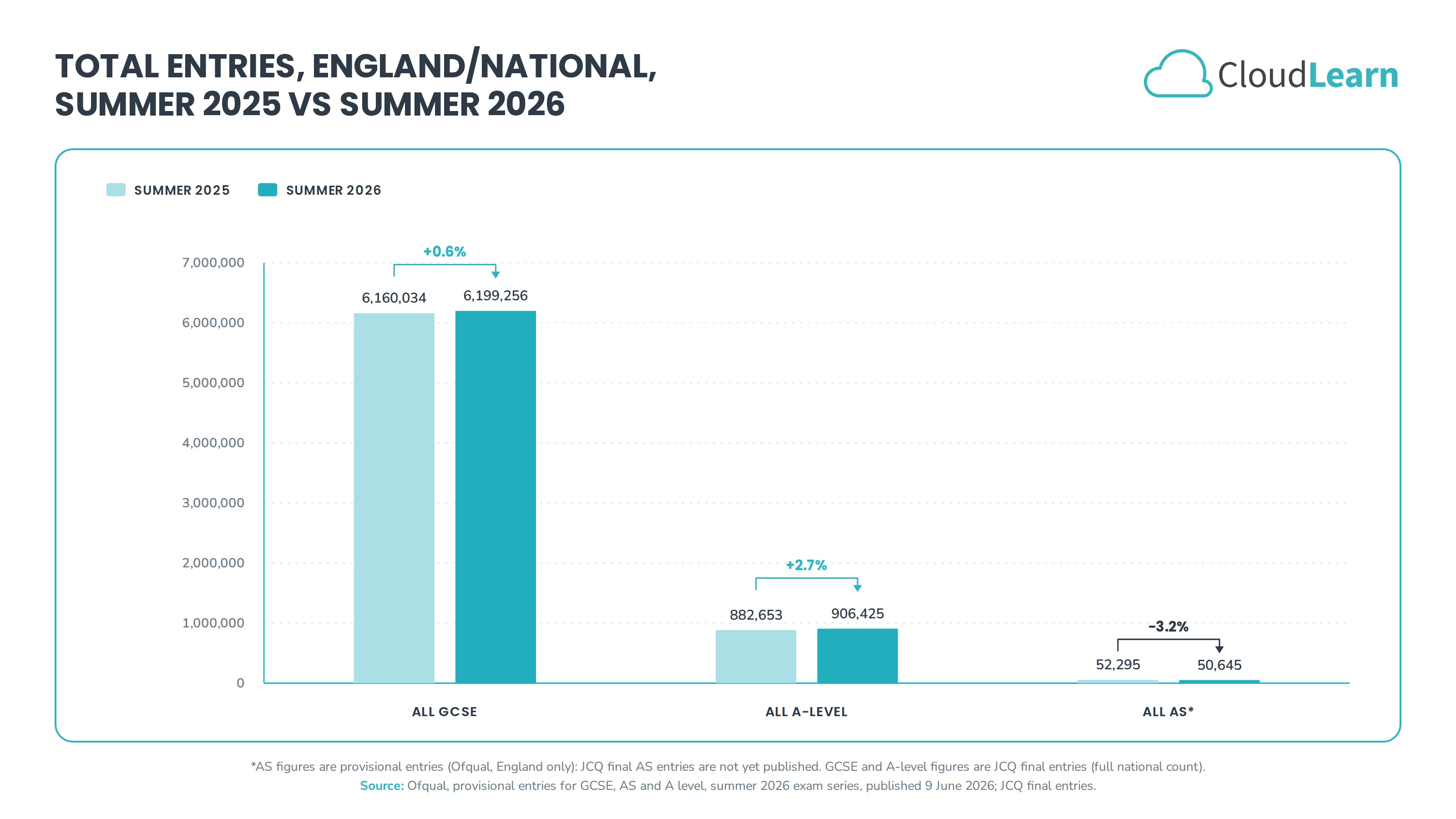
Total entries, England/national, summer 2025 vs summer 2026
| Entries | Summer 2025 (provisional) | Summer 2026 (provisional) | Summer 2025 (JCQ final) | Summer 2026 (JCQ final) |
| All GCSE | 5,777,020 | 5,840,185 | 6,160,034 | 6,199,256 |
| All A-level | 821,875 | 845,485 | 882,653 | 906,425 |
| All AS | 52,295 | 50,645 | not yet published | not yet published |
GCSE final entries are now in: JCQ’s national (UK-wide) results-day count is 6,199,256 for 2026 and 6,160,034 for 2025, both about 6% above the Ofqual provisional, England-only entries figures this article leads with — the same scope gap already flagged for A-levels. AS final entries are still not published separately. The two A-level figures do not reconcile cleanly, see note below the subjects section.
GCSE and A-Level Entries by Subject in 2026
Maths remains the largest riser among the 15 EBacc subjects. GCSE maths entries rose 2.4% to 876,955, and GCSE English language rose 2.2% to 844,455, according to Ofqual. Combined science rose 1.8% to 951,510.
Eight of the 15 EBacc subjects fell in 2026, and computing was the largest faller, down 7.0% to 83,330 entries. French continues its decline, down 5.5% to 121,040 entries, while Spanish (up 0.5% to 132,680) and German (up 0.3% to 32,525) held broadly flat by comparison.
Outside the EBacc, GCSE statistics was the largest riser of any subject in this dataset, up 11.9% to 39,360 entries, and business studies rose 8.5% to 141,135.
For students deciding on their subject choices, comparing these enrolment shifts with general difficulty rankings available in the overviews on the easiest GCSEs and the easiest A-levels can provide valuable context.
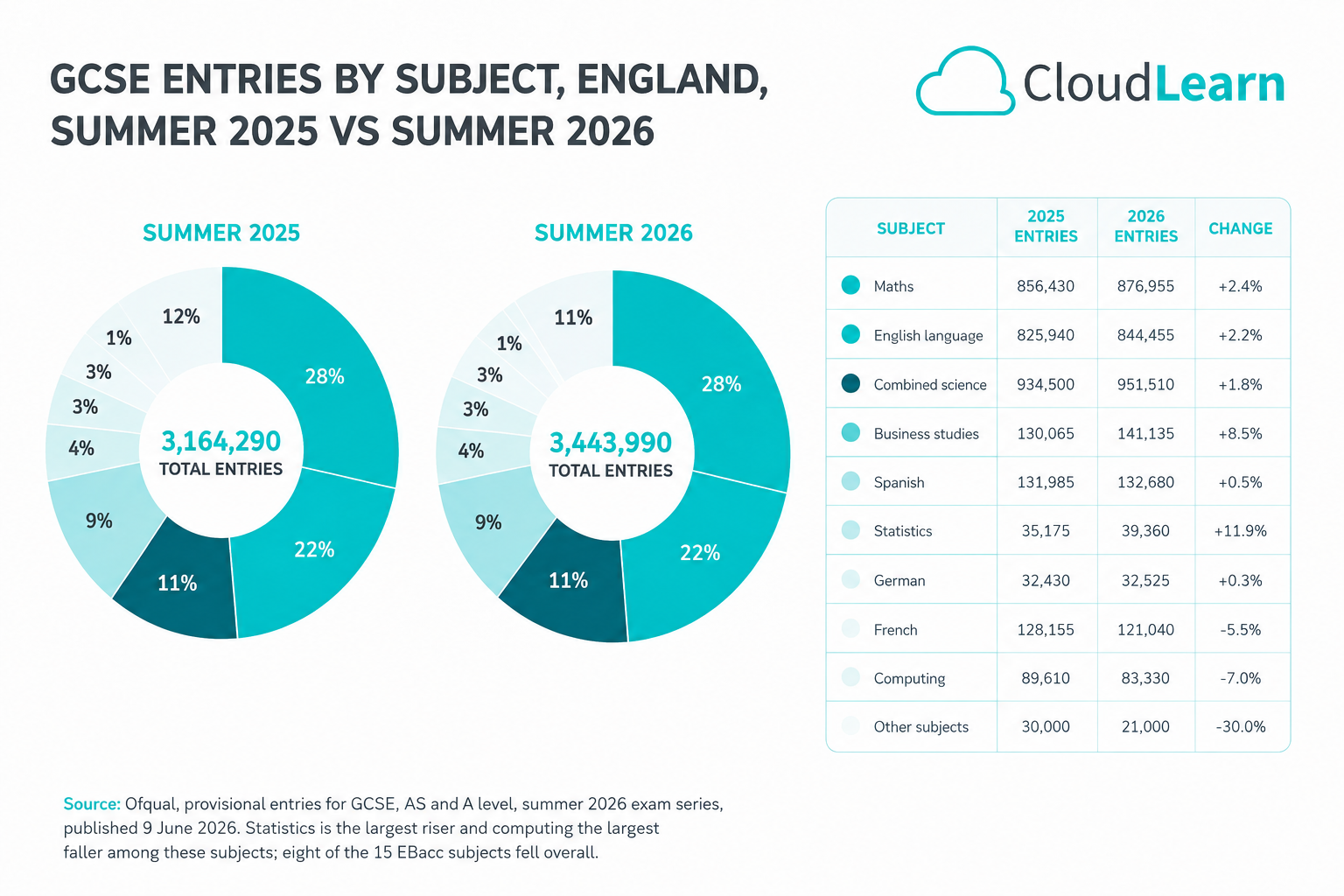
GCSE entries by subject, England, summer 2025 vs summer 2026
| Subject | Summer 2025 | Summer 2026 | Change |
| Statistics | 35,175 | 39,360 | +11.9% |
| Business studies | 130,065 | 141,135 | +8.5% |
| Maths | 856,430 | 876,955 | +2.4% |
| English language | 825,940 | 844,455 | +2.2% |
| Combined science | 934,500 | 951,510 | +1.8% |
| Spanish | 131,985 | 132,680 | +0.5% |
| German | 32,430 | 32,525 | +0.3% |
| French | 128,155 | 121,040 | -5.5% |
| Computing | 89,610 | 83,330 | -7.0% |
Source: Ofqual, provisional entries for GCSE, AS and A level, summer 2026 exam series, published 9 June 2026. Statistics is the largest riser and computing the largest faller among these subjects; eight of the 15 EBacc subjects fell overall.
At A-level, economics has broken into the five largest subjects for the first time. Entries rose 10.7% to 46,365 for summer 2026, according to Ofqual's provisional data, making it the fifth largest A-level subject, behind only maths, psychology, biology and chemistry; in 2025 it ranked eighth. Maths remains the only A-level subject with more than 100,000 entries, at 109,875, up 3.9% on the year.
Politics and law are growing fastest among the larger A-level subjects: political studies rose 13.1% to 23,560 entries and law rose 11.6% to 16,090, both comfortably ahead of the 2.9% rise in A-level entries overall. Further maths rose 8.6% to 20,340 and psychology rose 4.4% to 76,765. On the other side, English literature fell 5.8% to 32,890, drama fell 9.5% to 6,710 and classical subjects fell 9.6% to 5,655.
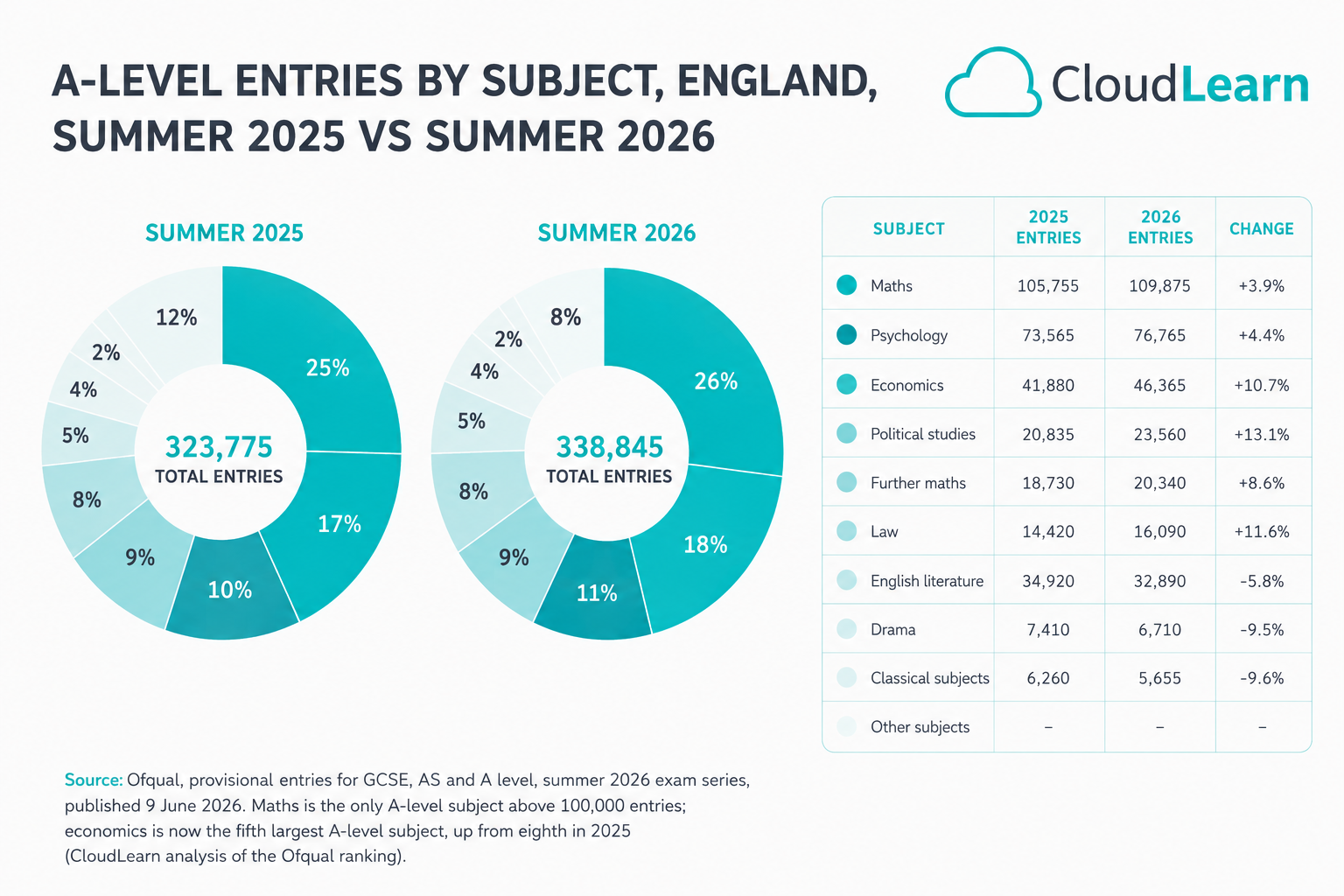
A-level entries by subject, England, summer 2025 vs summer 2026
| Subject | Summer 2025 | Summer 2026 | Change |
| Political studies | 20,835 | 23,560 | +13.1% |
| Law | 14,420 | 16,090 | +11.6% |
| Economics | 41,880 | 46,365 | +10.7% |
| Further maths | 18,730 | 20,340 | +8.6% |
| Psychology | 73,565 | 76,765 | +4.4% |
| Maths | 105,755 | 109,875 | +3.9% |
| English literature | 34,920 | 32,890 | -5.8% |
| Drama | 7,410 | 6,710 | -9.5% |
| Classical subjects | 6,260 | 5,655 | -9.6% |
Source: Ofqual, provisional entries for GCSE, AS and A level, summer 2026 exam series, published 9 June 2026. Maths is the only A-level subject above 100,000 entries; economics is now the fifth largest A-level subject, up from eighth in 2025 (CloudLearn analysis of the Ofqual ranking). JCQ’s detailed subject tables are now available (published alongside results, 13 August 2026) and give higher, UK-wide final entries for these same subjects: maths 115,380, psychology 79,201, economics 47,157, further maths 21,032, political studies (JCQ: "Politics") 24,824, law 16,526, English literature 36,196, drama and theatre 7,397, and classical subjects 5,717 combined. These are 1-10% above the provisional, England-only figures in the table, consistent with the scope gap already flagged below; JCQ has not published a matching subject-level breakdown for 2025, so a like-for-like % change cannot be calculated from these final figures, and the provisional 2025-vs-2026 comparison above is kept as the table’s basis for that reason.
A-level results for summer 2026 were published on Thursday 13 August 2026. 97.5% of entries achieved grade A* to E, unchanged from 2025, according to JCQ’s national results. The proportion awarded A* or A rose to 28.5%, from 28.3% in 2025, and 9.6% of entries achieved the top A* grade, up from 9.4%. Ofqual’s own England-specific summary gives a slightly different A*/A figure, 28.3% for 2026 against 28.2% in 2025; this piece leads with JCQ’s national count, consistent with how the resit section above cites JCQ and Ofqual together.
A-level outcomes, national, 2025 vs 2026
| Grade | 2025 | 2026 |
| A* to E (overall pass rate) | 97.5% | 97.5% |
| A* or A | 28.3% | 28.5% |
| A* only | 9.4% | 9.6% |
Source: JCQ, Level 3 results press notice, published 13 August 2026. Ofqual’s separate England-specific summary gives 28.2% and 28.3% for the A*/A rate in 2025 and 2026 respectively, a small but unreconciled difference from JCQ’s national figure.
Data note: entries figures do not fully reconcile. JCQ’s national entries count for summer 2026 is 906,425, against 882,653 for 2025, up 2.7%, both notably higher than the provisional entries this article originally reported (845,485 for 2026 and 821,875 for 2025), a gap of roughly 7% in both years, well beyond a typical provisional-to-final revision. The likely explanation is scope, Ofqual’s provisional release is England-only while JCQ’s results-day count is its full national total across all reporting centres, but CloudLearn has not confirmed this from the source releases and is flagging the gap rather than asserting a cause. The subject-level entries in the tables above remain the original provisional, England-only figures for that reason. JCQ’s detailed subject breakdown has since been checked (see the note above the A-level subjects table): it shows the same kind of gap at subject level, generally 1-10% above the provisional figures, which is consistent with a scope difference rather than a data error, but does not fully resolve it.
Some of this growth is demographic, not a shift in subject choice. The 18-year-old population in England rose 4.3% this year, from 702,050 to 732,335, and the 16-year-old population rose 1.2%, from 709,586 to 718,143, according to ONS projections cited by Ofqual.
Total A-level entries grew 2.9%, less than the rise in the 18-year-old population, so A-level uptake per head of the age group has, if anything, eased slightly rather than surged. That context matters for reading every entries figure in this section: a rising total does not necessarily mean a subject is becoming more popular per student.
GCSE Resits: Entries, Pass Rates and the 2026/27 Funding Rules
That is the highest recorded level. That is the highest recorded level, and a rise of 57.2% since summer 2022, when the equivalent figure was 313,210. On the same analysis, post-16 entries now make up 8.4% of all GCSE entries, up from 5.9% in 2022.
Data note: this figure could not be recalculated on a like-for-like basis from final data. JCQ’s results-day release does not break entries down by year group, so there is no "final" version of the year-12-and-above entries count this article can substitute in — the 492,330 figure above remains CloudLearn’s analysis of Ofqual’s provisional entry tables, unchanged. A related but not directly comparable figure has emerged from results-day reporting: FE News, citing JCQ, reports that entries from candidates aged 17 and over rose 3.7% to 500,277 in 2026, or 8.1% of all GCSE entries. That count uses a narrower age band (17+, rather than this article’s year 12 and above, which can include some 16-year-olds) and, going by the entries total implied, an all-UK rather than England-only denominator, so it is presented here as a separate cross-check rather than folded into CloudLearn’s own series.
Ofqual's tables show the two resit subjects that matter most for funding purposes have both grown their post-16 share: the year 12 and above share of GCSE maths entries rose from 26.4% to 27.1%, and for English language from 23.3% to 24.4%.
On CloudLearn's analysis, that puts approximately 237,600 of this year's maths entries and approximately 206,000 of this year's English language entries in the post-16 group, more than one in four maths entries. These are approximate figures: Ofqual rounds its own entry counts to the nearest 5, and the year-group percentages are rounded to one decimal place, so a precise-looking derived number would be false precision.
Post-16 (year 12+) GCSE entries, England
| Summer 2022 | Summer 2026 | Change | |
| Year 12+ GCSE entries | 313,210 | 492,330 | +57.2% |
| Share of all GCSE entries | 5.9% | 8.4% | – |
Figures are CloudLearn's own analysis of Ofqual's published entry tables, not numbers Ofqual publishes directly; see methodology for the arithmetic. Still provisional as of 20 August 2026 — JCQ’s results-day data does not include a matching year-group breakdown; see data note above.
| Year 12+ share of entries | Summer 2025 | Summer 2026 |
| GCSE maths | 26.4% | 27.1% |
| GCSE English language | 23.3% | 24.4% |
Source: Ofqual, provisional entries for GCSE, AS and A level, summer 2026 exam series, published 9 June 2026.
The most recently published outcomes for these resits are the summer 2026 results, out today. Candidates aged 17 and over achieved grade 4 or above in 15.3% of GCSE maths entries in 2026, from a cohort of 219,135, down from 17.1% of 206,732 entries in 2025 and 17.4% of 185,727 in 2024, according to results reported by FE Week and FE News from JCQ’s data, published 20 August 2026. The equivalent English language figure fell to 19.8% in 2026, from a cohort of 187,558 entries, against 20.9% in both 2025 and 2024 (175,118 and 148,569 entries respectively). For context, the pre-pandemic maths benchmark in 2019 was 21.2%, so the 2026 pass rate for this group now sits almost six points below where it stood before the pandemic, the widest gap in the series shown here.
Grade 4+ pass rate, candidates aged 17 and over
| Subject | 2024 | 2025 | 2026 |
| GCSE maths | 17.4% (185,727 entries) | 17.1% (206,732 entries) | 15.3% (219,135 entries) |
| GCSE English language | 20.9% (148,569 entries) | 20.9% (175,118 entries) | 19.8% (187,558 entries) |
Pre-pandemic maths benchmark (2019): 21.2%. Source: JCQ results reported by FE Week and Ofqual's results analysis, both published 21 August 2025.
The clearest pattern in the 2025 data is the age split. Candidates aged 20 and over passed English at 33.2% (5,178 candidates) against 19.7% (31,411 candidates) for those aged 17 to 19, and passed maths at 34.0% (6,746 candidates) against 15.3% (28,590 candidates) for the younger group, roughly double in both subjects. Adults who choose to resit are outperforming teenagers who are required to.
2025 grade 4+ pass rate by age
| Subject | Aged 17 to 19 | Aged 20 and over |
| GCSE maths | 15.3% (28,590) | 34.0% (6,746) |
| GCSE English language | 19.7% (31,411) | 33.2% (5,178) |
Source: JCQ results reported by FE Week and Ofqual's results analysis, both published 21 August 2025. These are different cohorts in different circumstances; the data does not explain the gap.
For 2026, only a narrower age breakdown has been published alongside results so far: candidates aged 17 specifically (the first resit cohort after year 11) passed English at 21.0%, down from around 22% in 2025, and maths at 16.4%, down from around 18.1% in 2025, according to Ofqual and FE News reporting on results day. A breakdown matching the 17-to-19-versus-20-and-over split above has not been published alongside the 2026 results; FFT Education Datalab’s fuller trend analysis, which typically follows within 24 hours of results day, had not yet covered this specific breakdown at the time of writing. The 2025 age-band figures above therefore remain the most detailed split currently available — worth checking again once FFT publishes.
The data does not explain why: these are different cohorts studying in different circumstances, and the gap should not be read as a causal claim about either group's ability. Still, more than 35,000 post-16 candidates gained grade 4 or above in maths for the first time in 2025, and more than 36,500 did so in English.
The funding rules are not changing for 2026/27. Students aged 16 to 18 without a grade 4 in GCSE maths or English must keep studying the subject as a condition of their institution's funding, with a minimum of 100 planned teaching hours a year for each subject and a 2.5% tolerance for excluded students, both unchanged from 2025/26. Institutions are encouraged, though not required, to add a further 35 hours of maths teaching.
Above the tolerance, funding is withdrawn at 50% of the national rate, and the 2026/27 data will affect 2028/29 allocations. Full-time students with a grade 3 must study towards a GCSE; those at grade 2 or below may take Functional Skills level 2 instead.
For an adult who left school without a grade 4, the practical choices have not changed much in recent years. Options include retaking the GCSE, working towards Functional Skills level 2 where the grade allows it, or studying through an adult or further education provider outside the school-leaver funding system.
CloudLearn's GCSE maths and GCSE English courses fall into that last category, often as a step towards a university preparation programme.
Elective Home Education: The 2025 Numbers
126,000 children in England were recorded in elective home education on census day in autumn 2025, according to the Department for Education, up from 111,700 a year earlier. That is 1.5% of the 5 to 16 population, and it is a single day's snapshot.
A second, broader DfE figure covers the full year: 175,900 children were in elective home education at some point during 2024/25, up from 153,300 in 2023/24. Of those, 78,000 started elective home education during the year, up from 71,500 in 2023/24, and 28,100 returned to school during the same period, up from approximately 21,500 the year before.
Elective home education, England
| Figure | 2023/24 or autumn 2024 | 2024/25 or autumn 2025 |
| Census-day count (autumn) | 111,700 | 126,000 |
| Rate as share of 5 to 16 population | n/a | 1.5% |
| In EHE at any point during the year | 153,300 | 175,900 |
| Started EHE during the year | 71,500 | 78,000 |
| Returned to school during the year | approx. 21,500 | 28,100 |
Source: Department for Education, Elective home education, autumn term 2025/26, published 15 January 2026, updated 29 January 2026. This is official statistics in development; see caveat below.
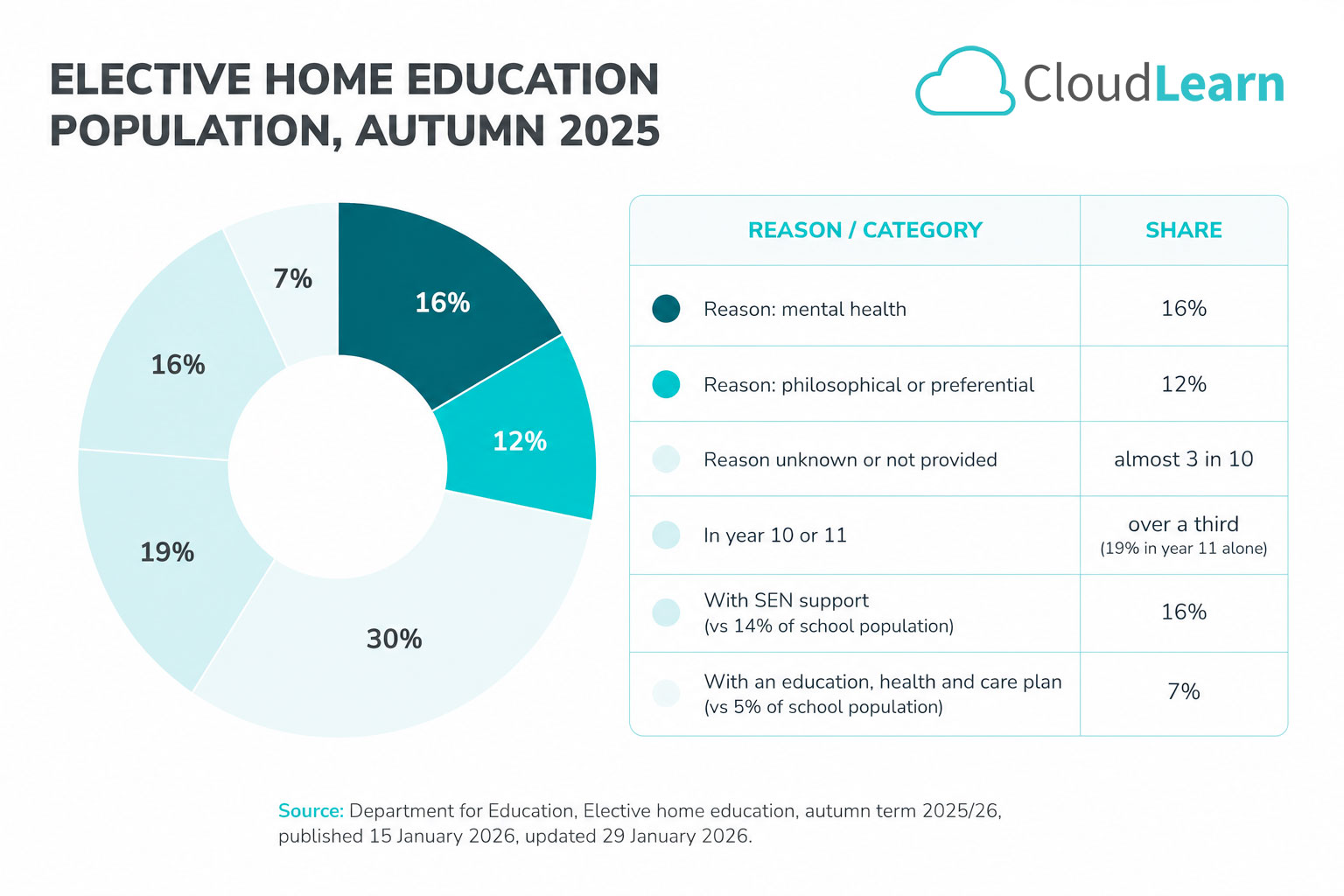
The reasons parents give have stayed fairly consistent. Mental health was the most commonly reported reason, cited in 16% of cases, ahead of philosophical or preferential choice at 12%. Almost three in ten records give no reason or an unknown one, which the Department for Education does not attempt to categorise further.
Children in year 10 or 11 make up over a third of the elective home education population, with 19% in year 11 alone. The group also has higher rates of additional need than school-educated children: 16% have SEN support against 14% of the school population, and 7% have an education, health and care plan against 5% of the school population. Local authorities issued approximately 7,400 school attendance orders under section 437(1) in 2024/25, up about 6% on the year.
Elective home education population, autumn 2025
| Share | |
| Reason: mental health | 16% |
| Reason: philosophical or preferential | 12% |
| Reason unknown or not provided | almost 3 in 10 |
| In year 10 or 11 | over a third (19% in year 11 alone) |
| With SEN support (vs 14% of school population) | 16% |
| With an education, health and care plan (vs 5% of school population) | 7% |
Source: Department for Education, Elective home education, autumn term 2025/26, published 15 January 2026, updated 29 January 2026.
The Department for Education classifies this whole collection as official statistics in development. It only became a mandatory return from local authorities in autumn 2024, and the department states explicitly that changes over time are likely to be partly explained by improvements in data quality rather than by underlying change alone. That caveat applies to every figure in this section, including the year-on-year rises above.
Adult Essential Skills: Participation and the Apprenticeship Rule Change
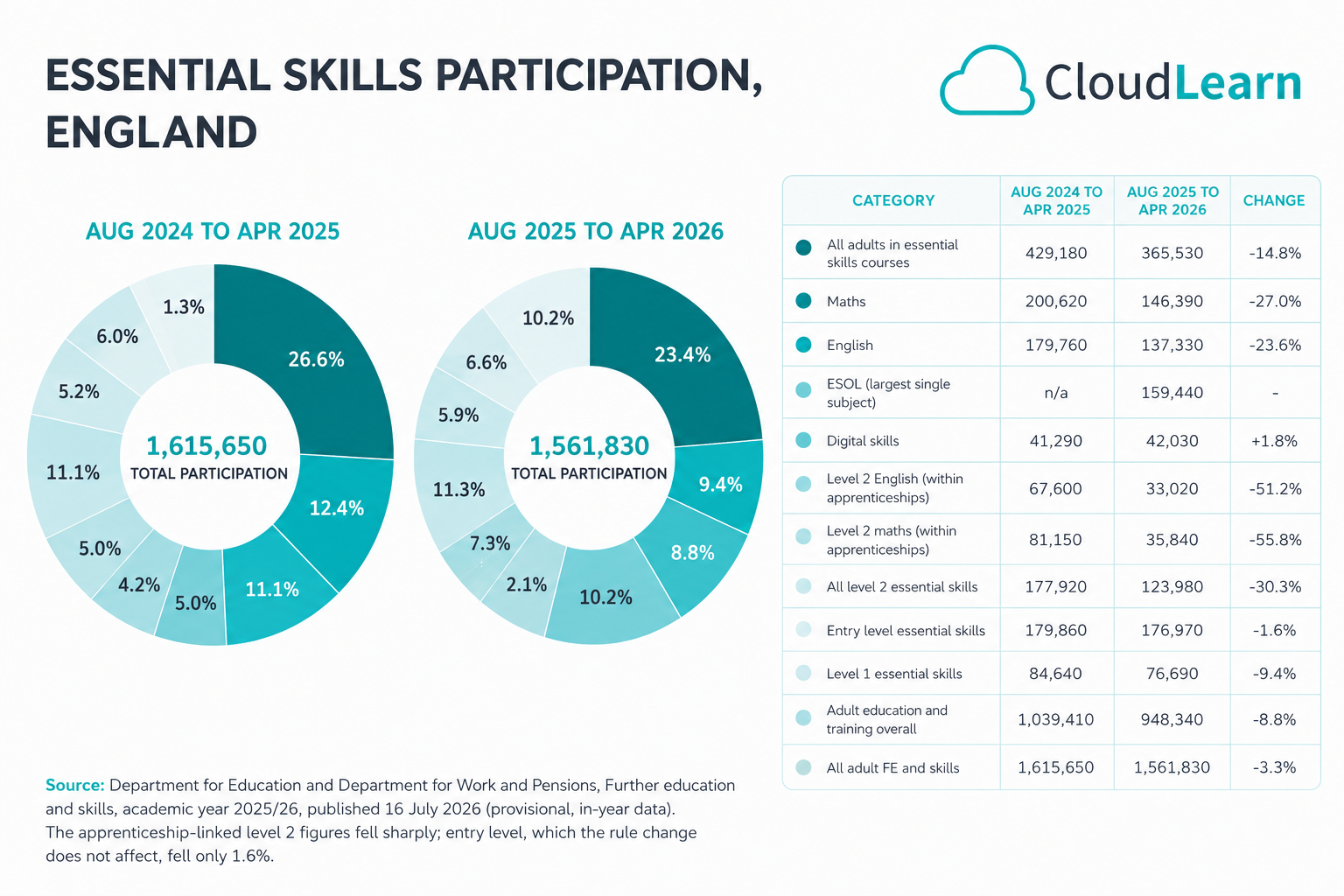
365,530 adults took part in essential skills courses in England between August 2025 and April 2026, according to provisional Department for Education and Department for Work and Pensions figures published 16 July 2026, down 14.8% on the 429,180 recorded over the same period a year earlier.
ESOL was the largest single subject, with 159,440 learners, ahead of maths and English individually. Maths participation fell 27.0% to 146,390 and English fell 23.6% to 137,330, while digital skills was the one subject to grow, up 1.8% to 42,030.
The fall is not straightforwardly a story of adults abandoning learning, and the department's own release points to a more specific cause. Since February 2025, apprentices aged 19 and over no longer need level 2 English and maths to complete their apprenticeship, and that single rule change explains most of the movement in the headline number. Level 2 English within apprenticeships fell 51.2% to 33,020 and level 2 maths within apprenticeships fell 55.8% to 35,840, and across all level 2 essential skills courses, participation fell 30.3%.
By contrast, entry level essential skills participation, which the apprenticeship rule change does not touch, fell only 1.6% to 176,970, and level 1 essential skills fell 9.4% to 76,690. Adult education and training overall fell 8.8% to 948,340, and all adult further education and skills participation fell 3.3% to 1,561,830.
Essential skills participation, England
| Aug 2024 to Apr 2025 | Aug 2025 to Apr 2026 | Change | |
| All adults in essential skills courses | 429,180 | 365,530 | -14.8% |
| Maths | 200,620 | 146,390 | -27.0% |
| English | 179,760 | 137,330 | -23.6% |
| ESOL (largest single subject) | n/a | 159,440 | – |
| Digital skills | 41,290 | 42,030 | +1.8% |
| Level 2 English (within apprenticeships) | 67,600 | 33,020 | -51.2% |
| Level 2 maths (within apprenticeships) | 81,150 | 35,840 | -55.8% |
| All level 2 essential skills | 177,920 | 123,980 | -30.3% |
| Entry level essential skills | 179,860 | 176,970 | -1.6% |
| Level 1 essential skills | 84,640 | 76,690 | -9.4% |
| Adult education and training overall | 1,039,410 | 948,340 | -8.8% |
| All adult FE and skills | 1,615,650 | 1,561,830 | -3.3% |
Source: Department for Education and Department for Work and Pensions, Further education and skills, academic year 2025/26, published 16 July 2026 (provisional, in-year data). The apprenticeship-linked level 2 figures fell sharply; entry level, which the rule change does not affect, fell only 1.6%.
Read together, the contrast between those figures is the story: a requirement has been removed for one specific group of adult learners, and participation in the qualifications tied to that requirement has fallen sharply, while participation among adults who were never subject to it has barely moved. That is a materially different claim from adult demand for essential skills collapsing across the board.
Results day 2026: what happens and when
A-level, AS and T Level results were published on Thursday 13 August 2026, and GCSE, VTQ and Entry Level results followed on Thursday 20 August 2026, both according to Ofqual’s student guide to exams and assessments in 2026. Results were released to schools and colleges the day before each date, under restricted release. For reference, GCSEs taken in the November 2025 resit series were released to students on Thursday 8 January 2026.
This article has now had both of its planned 2026 results-day updates. The 13 August update added that day’s A-level, AS and T Level outcomes to the subjects section and the key findings block. The 20 August update above added the 2026 GCSE resit outcomes and the all-age GCSE grade 4+ and grade 7+ figures, alongside the summer 2025 and 2024 baselines used throughout this version. Every figure either update replaced as the headline comparison has stayed in the article as prior-year context, rather than being deleted.
Methodology and Sources
This article draws on six published sources. Three cover this year's entries and outcomes: Ofqual's provisional entries for GCSE, AS and A level, summer 2026 exam series (9 June 2026); Joint Council for Qualifications results for summer 2025, reported by FE Week and analysed by Ofqual (21 August 2025); and Ofqual's student guide to exams and assessments in 2026. Three cover funding and wider participation: the Department for Education's condition of funding guidance for 2026/27 (updated 10 March 2026); the Department for Education's elective home education statistics for autumn term 2025/26 (15 January 2026, updated 29 January 2026); and the Department for Education and Department for Work and Pensions' further education and skills statistics for 2025/26 (16 July 2026). Two further sources cover the 20 August GCSE update specifically: Ofqual’s "GCSE, level 1 and 2 results 2026 at a glance" blog post and FFT Education Datalab’s results-day analysis, both published 20 August 2026.
Entry figures compare summer 2026 provisional entries, as submitted to exam boards by 15 April 2026 and rounded by Ofqual to the nearest 5, against summer 2025 final entries. They are provisional and may change; JCQ’s results-day entries totals for GCSE and A-level are now available and are shown as a cross-check in the total entries table, but do not currently reconcile cleanly with Ofqual’s provisional figures (see the data notes in the subjects and resits sections). Resit outcome figures for maths and English pass rates are the most recently published results, from summer 2026; the age-band breakdown (17-19 versus 20-and-over) is still the summer 2025 data, as a matching 2026 breakdown was not available at the time of writing.
Three figures in this article, the post-16 GCSE entries total, its growth since 2022 and its share of all GCSE entries, are CloudLearn's own calculations from Ofqual's published entry tables rather than figures Ofqual publishes directly. The arithmetic: 492,330 divided by 5,840,185 gives the 8.4% share of all GCSE entries, and 492,330 against 313,210 gives the 57.2% growth figure since 2022. They are presented as CloudLearn analysis of Ofqual data throughout, and are approximate for the rounding reasons set out above. This total could not be recalculated against a "final" entries release, because JCQ’s results-day data is not broken down by year group; a separate, narrower age-17-plus entries figure from JCQ (500,277, cited via FE News) is presented alongside it in the resits section as a cross-check rather than a replacement.
How to Cite This Research
To cite this research: CloudLearn, "The State of GCSEs and A-Levels in 2026: What the Data Tells Us Before Results Day", CloudLearn, 2026, https://cloudlearn.co.uk/article/the-state-of-gcses-and-a-levels-in-2026. Charts from this article may be reused by other publications with attribution to CloudLearn and a link back to this page.
