


How to Find the Best University Course for You With The Right Questions

October 29, 2026 | 3 days | Hacks & Tips
In This Article:
- Start with your strongest subjects and genuine interests
- Check whether your career idea needs a specific degree
- Find out which degrees your A-Levels (and GCSEs) open
- Read past the course title
- Check the entry requirements that aren't about grades
- Choose the type of course and the way you want to study
- Try the subject before you commit
- Shortlist courses you can write one personal statement for
- Five questions to answer before you apply
- FAQs
 Summarise this article with ChatGPT | Perplexity | Claude | Google AI Mode | Grok
If you've spent an evening scrolling through UCAS course search and closed the laptop feeling more confused than when you started, you're not alone. Almost every student hits this wall at 16 or 17. You're asked to choose what you'll study for the next three or four years while you're still in the middle of your A-Levels.
When students come to us stuck at this point, we tell them the same thing: you don't need a life plan. You need to answer a few questions honestly and in the right order.
In our experience, the students who end up happy on their course checked these things before they applied:
| ✓ What to look at | ✗ What not to rely on |
| What you enjoy enough to study almost every day for three years. | What sounds impressive, or what your friends are applying for. For example, you shouldn't choose law because it sounds prestigious when you dread long essays and heavy reading. |
| Whether your career idea needs a specific degree, or whether any subject will do. | Assuming every job needs a matching degree (most graduate jobs don't). For a graduate scheme in business or marketing, a history or maths graduate can apply alongside a business graduate. |
| Which degrees your A-Levels and GCSEs already open, and how to close any gaps. | Falling for a course before checking its required subjects. |
| The module list and how you'll be assessed: what you'll study each year, how many hours you'll spend in lectures, and whether your grade comes mainly from exams or from coursework. | The course name alone. "Psychology" at one university might be mostly statistics and neuroscience; at another, mostly social and child psychology. |
| The entry requirements that aren't about grades. Most medicine courses ask for the UCAT, many art and design courses ask for a portfolio, and Oxford and Cambridge often interview. |
Getting the A*AA a medicine course asks for, then missing out because you didn't sit the UCAT or line up any work experience. |
| Whether you've tried the subject, by watching a university taster lecture or reading the first chapter of a book from the first-year reading list. | Guessing from the school version. |
1) What would you happily study on a rainy Tuesday? Start with your strongest subjects and genuine interests
The right course is usually the one you'd enjoy reading about on a completely ordinary day, because that's what a degree mostly is: lectures, reading and assignments on the same subject, week after week.
Try this.
Take a sheet of paper and make three columns:
- The subjects you're best at (your strongest grades).
- The topics you look up for fun: documentaries, podcasts, the rabbit holes you fall into online.
- How you like to work: with people, with data, or hands-on.
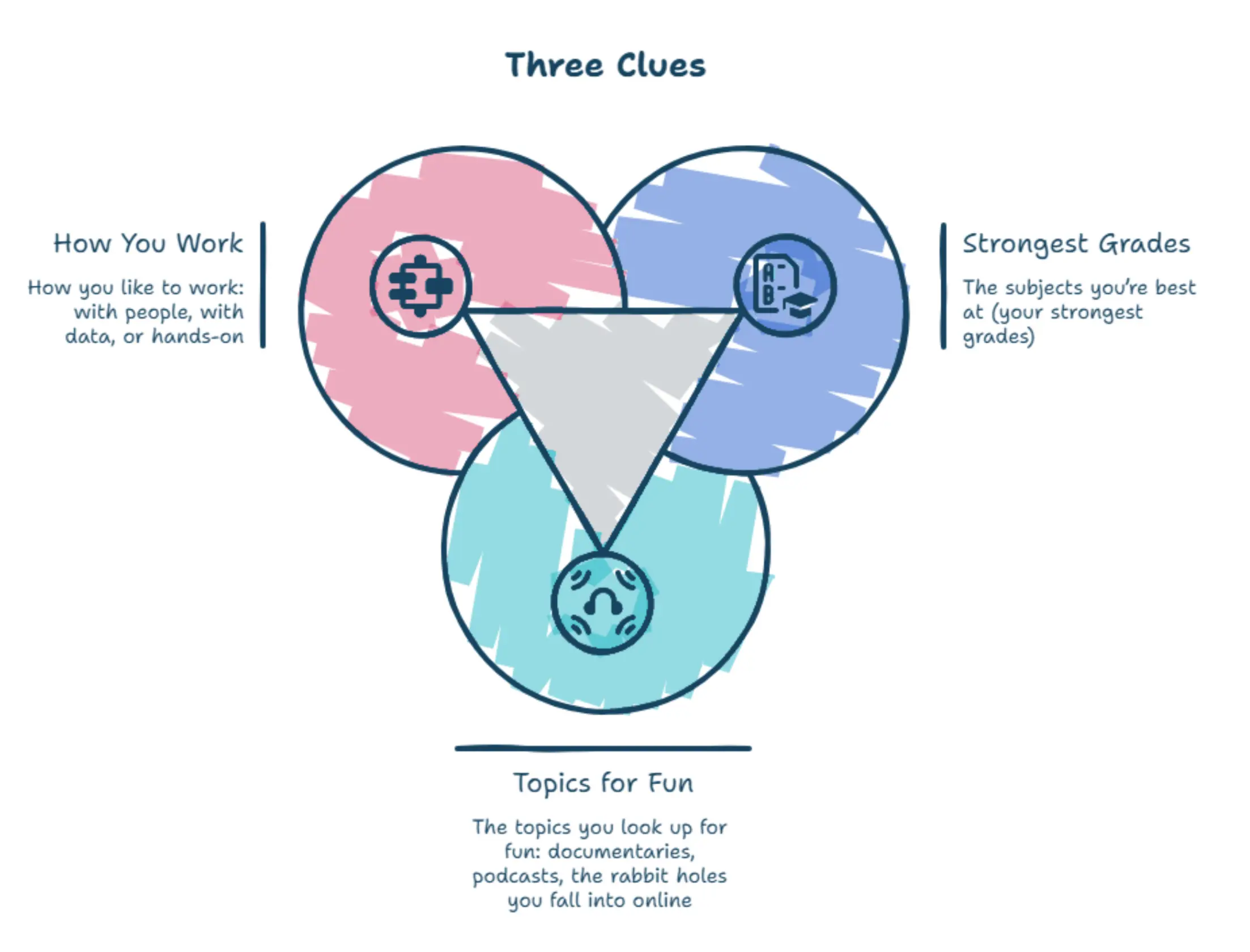
Now look for overlaps. Say your best subjects are biology and chemistry, you watch every true-crime documentary going, and you love practical work in the lab. Forensic science, biomedical science and pharmacology could all belong on your list, even if you'd never heard of two of them before today.
That last point matters. Plenty of degrees aren't taught at school at all: criminology, anthropology, linguistics, pharmacology, architecture. Don't limit yourself to the subjects you already take.
It also helps to know the difference between a subject and a course. Biological sciences is the subject. Marine biology, zoology and biochemistry are courses within it. Start broad, then narrow down.
Torn between two subjects? A joint honours degree, such as History and Politics or Maths and Economics, lets you study both. Just be aware that you'll be juggling two departments, with different styles of teaching and assessment.
One honest warning: don't pick a course because your friends are doing it or because it sounds impressive at family dinners. You're the one who'll be writing the essays at midnight.
If you're studying with CloudLearn, ask your tutor which topics you seem most at home with. They see your work every week, and they often spot a strength you've overlooked.
2) Check whether your career idea needs a specific degree
Some careers need a specific degree, often one approved by a professional body. Many graduate jobs, on the other hand, accept a degree in any subject. Knowing which group your career idea falls into changes how much freedom you have.
Roughly, careers fall into three groups:
- You need a specific degree: medicine, dentistry, nursing, veterinary science, physiotherapy.
- A related, accredited degree makes life much easier: engineering, psychology, architecture, accountancy.
- Most subjects are welcome: many graduate schemes in business, marketing, management and the civil service.
Here's how that plays out. If your plan is "something in business", you don't need a business degree; an economics, history or maths graduate can apply for the same graduate schemes. If your plan is "clinical psychologist", it's a different story. You'll want a psychology degree accredited by the British Psychological Society, followed by further postgraduate training.
Accreditation is easy to miss. For psychology, check for BPS accreditation. For architecture, check that the course is recognised by RIBA and the ARB. For engineering, look for accreditation by a professional engineering institution. You'll usually find it on the course page; if you can't, email the admissions team and ask.
Two free tools help here:
- Prospects job profiles explain the entry routes for hundreds of careers, including whether a specific degree is required.
- Discover Uni shows what graduates of each course went on to do and earn.
Not sure about a career yet? That's completely normal. Stick to a broad subject you enjoy and avoid very narrow vocational courses until you're surer. You can specialise later.
Not sure which course to pick? Get 1:1 tutor support with our University Preparation Programme.
3) Find out which degrees your A-Levels (and GCSEs) open
Your A-Level subjects narrow your options more than you might think, so check a course's required subjects before you fall in love with it.
Here's a quick guide to some popular degrees. Requirements vary between universities, so always confirm them on the course page.
| Degree | Usually asks for | What gives you an edge | Worth knowing |
| Medicine | A-Level chemistry at most medical schools, and at many of them biology too. Your third subject is usually up to you. |
Strong GCSEs across the board, especially in maths, English and the sciences, as many medical schools look closely at them. | Most courses ask you to sit the UCAT in the summer before you apply, show work experience or volunteering in a caring role, and pass an interview. For most medicine courses, the UCAS deadline is 15 October. Read more: A-Levels for medicine and GCSEs for medicine |
| Engineering | Maths for almost every course, and physics for most (mechanical, electrical, civil, aerospace). Chemical engineering usually asks for maths and chemistry. |
Further maths, which top universities value highly. | Look for courses accredited by a professional engineering institution if you want to become a chartered engineer. Many courses offer a four-year MEng. Read more: A-Levels for engineering |
| Economics | Maths at most universities, and almost always at the most competitive ones. | Further maths. You don't need A-Level economics: many students start the degree without it. |
Some universities ask for an admissions test: LSE, for example, requires the TMUA for its BSc Economics. Expect a lot of maths and statistics, especially in a BSc. |
| Law | No specific subjects at most universities. | Essay-based subjects such as English literature or history, which train you to build an argument and read closely. | A number of universities, including Oxford, Cambridge and several London universities, use the LNAT. You don't need a law degree to become a solicitor in England and Wales, but if you know law is your path it's the most direct route. Read more: the best A-Levels for law |
| Architecture | Often no specific subjects, though some universities ask for maths or physics. | A mix of a creative subject (art, design) and an analytical one (maths, physics). | Almost every course asks for a portfolio, and many interview. Becoming a fully qualified architect usually takes around seven years, so choose a course recognised by RIBA and the ARB. Read more: what A-Levels you need for architecture |
| Psychology | Often no specific subjects, but some universities ask for at least one science or maths. | Biology or maths, because a psychology degree involves far more statistics and research methods than most students expect. | Many universities ask for a solid GCSE maths grade. If you want to become a psychologist, choose a course accredited by the British Psychological Society. Read more: A-Levels to become a psychologist |
| Computer Science | Maths at most universities. | Further maths or physics. You don't need A-Level computer science, although it helps. | Some top universities ask for an admissions test: Imperial, for example, requires the TMUA. Showing projects you've built in your own time, such as an app, a website or a game, strengthens your personal statement. |
Don't forget your GCSEs. Many courses ask for at least a grade 4 or 5 in English and maths, and competitive courses such as medicine often ask for higher grades across several subjects.
Spotted a gap? It happens far more often than you'd think.
Say you're in Year 12 taking biology, psychology and English, and you've just realised you'd love to study medicine. Without chemistry, most medical schools won't consider you. You still have options:
- Add the missing A-Level. With online A-Level courses you can study it alongside your current subjects at your own pace, or speed things up with an A-Level fast track.
- Resit to raise a grade. You can resit A-Levels or resit GCSE maths or English if a grade is holding you back.
- Look for a foundation year. Some degrees offer an extra preparatory year for students without the right subjects or grades.
Looking to Excel in Your A-Level Exams?
Get the A-Levels you need at CloudLearn!
View our A-Level courses
4) Read past the course title
Two courses with exactly the same name can be completely different, so the module list, teaching style and assessment matter far more than the title.
Take psychology. At one university it might lean heavily on statistics and neuroscience; at another, on social and developmental psychology. Same name on the certificate, very different three years.
Open the course page and check:
- The modules, year by year. Which ones are compulsory and which are optional? Does year one excite you, or does it look like something to get through?
- BA or BSc. Some subjects come in both. A BA in geography tends to focus on human geography and essays, while a BSc leans towards physical geography and data.
- Contact hours and independent study. A humanities course might give you a handful of hours a week plus a lot of reading; a science or engineering course usually means more lectures and lab time. Neither is better, but one will suit you more.
- Assessment. Exams, coursework, presentations, a dissertation? If you freeze in exams but shine in coursework, the mix really matters.
- The extras. A placement year (sometimes called a sandwich year), a year abroad, or an integrated master's, which adds a fourth year and a master's-level qualification (MEng, MSci) without a separate application.
Planning to study in Scotland? Most degrees there last four years rather than three, which can mean an extra year of fees for students from elsewhere in the UK.
A quick tip: put the module lists of two courses with the same title side by side and highlight every module you'd look forward to. The one with more highlights is usually your answer.

5) Check the entry requirements that aren't about grades
Grades are only part of the picture. Many courses add tests, interviews, portfolios or background checks, and some of these have much earlier deadlines.
Look out for:
- Admissions tests: the UCAT for most medicine and dentistry courses, the LNAT for law at some universities, and subject tests for many Oxford and Cambridge courses.
- Interviews: common for medicine, dentistry, veterinary science and Oxford and Cambridge, and for many teaching and healthcare courses.
- Portfolios or auditions: for art and design, architecture, music and drama.
- Work experience: expected for medicine, veterinary science, nursing and other healthcare courses.
- Checks: a DBS check for courses involving work with children or vulnerable adults, and fitness to practise for courses such as medicine.
- English language requirements for international students.
Timing is where students get caught out. If you're aiming for medicine, you sit the UCAT in the summer before you apply, so you need to have decided by the end of Year 12.
Applications for medicine, dentistry, veterinary science and Oxford and Cambridge close on 15 October of the year before you start; most other courses close in mid-January.
Coming back to study as an adult? If you're over 21 when you start, universities usually treat you as a mature student and are often more flexible. They may accept an Access to HE Diploma, relevant work experience or A-Levels taken later in life, and old GCSE grades still count.
If you need to refresh your qualifications first, A-Level courses for adults are designed to fit around work and family.
6) Choose the type of course and the way you want to study
Not every university course is a three-year bachelor's degree. The right type depends on your grades, your goals and how you want to learn.
| Type of course | Typical length | Good for you if... |
| Bachelor's degree (single, joint or combined honours) | 3 years (4 in Scotland, or with a placement year) | You want the standard route into a subject |
| Integrated master's | 4 years, sometimes 5 | You're set on engineering or science and want a master's-level qualification |
| Foundation year ("year zero") | 1 extra year before the degree | You're missing the grades or subjects for direct entry |
| Foundation degree | 2 years, plus an optional top-up year | You want a vocational, employer-linked route |
| HNC / HND | 1 year / 2 years | You want a work-related qualification that can lead to a degree |
| Degree apprenticeship | Varies by programme | You want to earn a salary and gain work experience while you study |
| Accelerated degree | 2 years | You want the same content as a standard degree, finished a year sooner |
A foundation year and a foundation degree sound alike but are quite different. A foundation year is a preparatory year that leads into a full degree. A foundation degree is a qualification in its own right.
Think about how you want to study, too. As well as full-time, there's part-time, distance learning and blended learning. For many part-time and distance courses, you apply directly to the university, not through UCAS.
Did You Know CloudLearn Offers a University Preparation Programme?
Alongside your GCSE or A-Level studies, get expert guidance on personal statements, UCAS, and securing your place at university.
Find out more
7) Try the subject before you commit
Reading about a subject isn't the same as studying it. A few hours of testing it now can save you three years on the wrong course.
Easy ways to try a subject:
- Taster lectures. Universities run taster sessions, and UCAS highlights Subject Spotlights from Springpod, led by university lecturers.
- Free online short courses. Many UK universities publish free introductory courses on platforms such as FutureLearn.
- The first-year reading list. Most course pages link to one. Borrow a book from the list: if you can't get past chapter one, that tells you something.
- Current students. UCAS lets you chat to students on the courses you're considering.
- Summer schools and UCAS Discovery events, where you can meet lots of universities in one day.
Try a weekend experiment: watch a taster lecture on Saturday and read the first chapter of a first-year textbook on Sunday. If you finish both wanting more, that's a very good sign.

8) Shortlist courses you can write one personal statement for
You can choose up to five courses on UCAS, but you write one personal statement for all of them, so keep your choices within the same subject area.
For example, applying for psychology at four universities and criminology at a fifth works, because the interests overlap. Four psychology courses and one in graphic design won't, because a single statement can't convince both sets of admissions tutors.
A few limits to know:
- Medicine, dentistry and veterinary science: a maximum of four choices in the same subject.
- Oxford and Cambridge: usually only one of the two in the same cycle.
Once your courses are clear, deciding how to spread them across universities (a stretch choice, realistic choices and a safety net) and getting the most out of open days is the next step. We cover both in our guide on how to choose the best university for you.
9) Five questions to answer before you apply
Before you press submit, check that you can answer each of these with confidence:
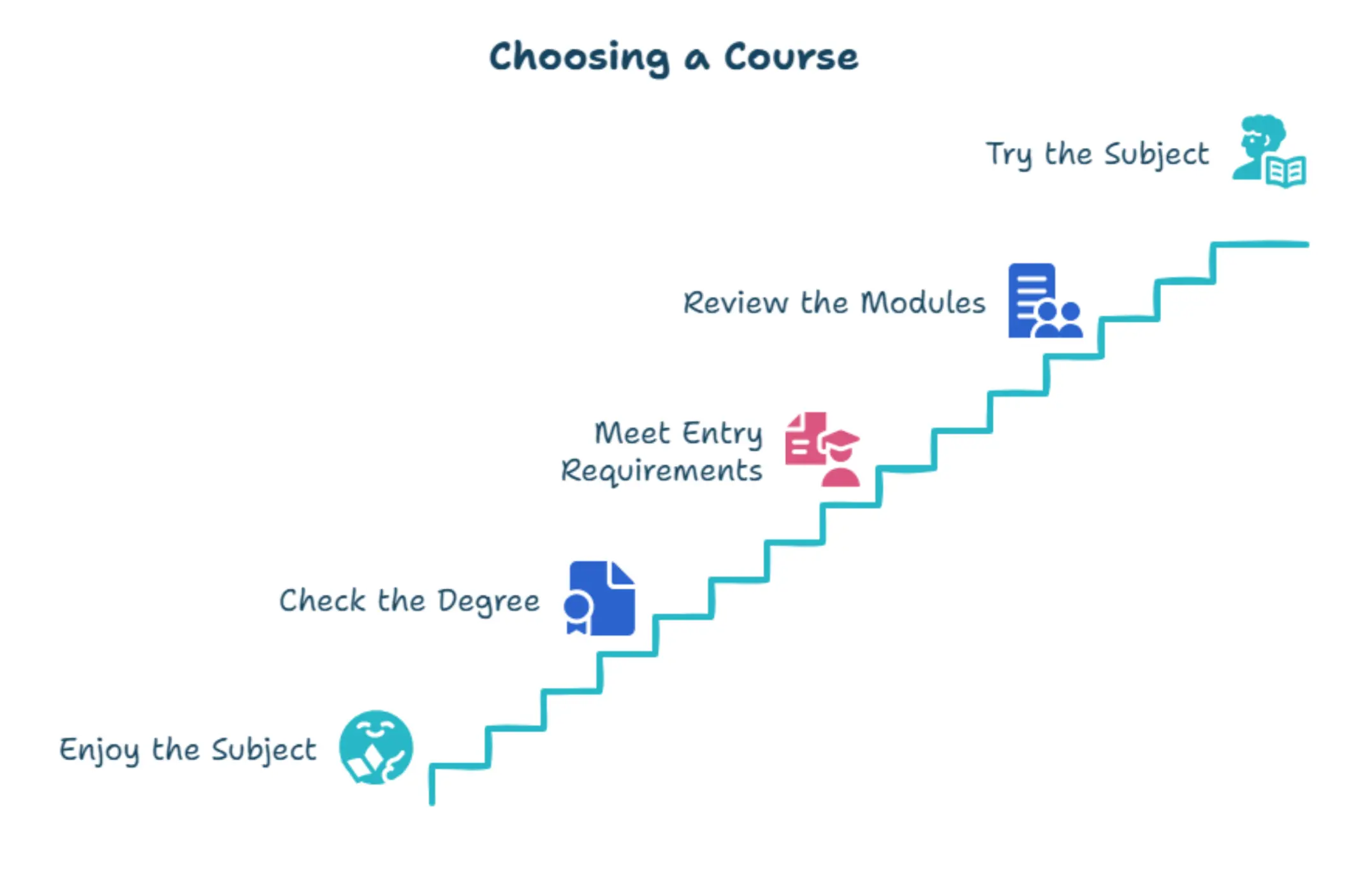
- Would I happily study this subject on an ordinary Tuesday afternoon?
- Does my career idea need a specific or accredited degree, and does this course offer it?
- Do I have the A-Level and GCSE subjects and grades it asks for, or a plan to get them?
- Have I read the module list and checked how it's assessed?
- Have I tried the subject in some way: a taster, a book, a conversation with a student?
If one answer is shaky, that's where to dig a little deeper. It doesn't mean you've chosen badly.
Want someone to work through it with you? Our University Preparation Programme pairs you with a tutor for 1:1 video calls. It includes course and university research frameworks, personal statement coaching, admissions interview preparation and UCAS timeline planning.
Frequently Asked Questions
How do I know what university course is right for me?
The right course matches what you enjoy, what you're good at and what your A-Levels allow you to apply for. Start by listing your strongest subjects and interests, check whether your career idea needs a specific degree, then compare the module lists and entry requirements of a few courses. If you can, try the subject first through a taster lecture or a free online course.
Need extra guidance? Explore our University Preparation Programme for course selection support and 1:1 tutor advice.
Is there a quiz to find the best university course for me?
Yes. The UCAS careers quiz suggests job ideas and the subjects linked to them, and several universities offer course-matching quizzes. Use them as a starting point, not an answer: a quiz can't read a module list or check your A-Level subjects for you.
Should I choose a course for career prospects or because I enjoy it?
Ideally both, but enjoyment should carry a lot of weight. You'll study the subject almost every day for three years, and most graduate jobs don't require a specific degree. If your chosen career does need one (medicine or nursing, for example), that settles it. Otherwise, check graduate outcomes on Discover Uni and weigh them against how much you like the subject.
What if my grades or A-Level subjects aren't right for the course I want?
You have more options than you think. You can add a missing A-Level, resit to improve a grade, or look for courses with a foundation year. Another route is an HND or foundation degree, which you can top up to a full bachelor's degree later.
Check the course page too: some universities make contextual offers with lower grade requirements for students who meet certain criteria.
What's the difference between a BA and a BSc?
They're both bachelor's degrees, but the emphasis differs. A BA usually leans towards essays, theory and discussion, while a BSc tends to be more scientific, technical or data-based. Some subjects, such as geography, economics and psychology, are offered as either, so compare the modules rather than the letters.
What's the difference between a foundation year and a foundation degree?
A foundation year is a one-year preparatory course that leads into a full bachelor's degree, usually at the same university. A foundation degree is a standalone two-year vocational qualification, equivalent to the first two years of a degree, which you can top up to a full bachelor's with an extra year.
What if I choose the wrong course?
Talk to your personal tutor or the course team as early as you can. Many universities let you switch to a related course, especially in the first year. If you decide to leave and reapply, speak to Student Finance first, because changing course can affect your funding.
When should I start researching university courses?
Ideally during Year 12, or your first year of A-Levels. Start earlier if you're considering medicine, dentistry, veterinary science, or Oxford and Cambridge, because of the admissions tests and the 15 October deadline.
When you've found a course that fits, the next step is a strong application. Explore our University Preparation Programme for 1:1 tutor support, or browse our online A-Level courses to make sure you have the subjects that open the right doors.
